Every Monday, their sales director prepared for the pipeline review the same way — piecing together information from HubSpot, activity logs, email threads, and call recordings if he had time (which he usually didn't). It would take an entire morning, and as you can imagine, not something he was looking forward to.
He could just ask the AE. But that meant pulling someone off their pipeline to give a verbal recap of something that should've been written down somewhere. And AEs knew their deals — they just didn't write any of it down in a way someone else could use. Context lived in the head of the person running the deal, and nowhere else.
In an attempt to fix it, leadership built a structured document — one template per deal, mapped to their sales methodology. After each call, the AE updates it — objections heard, stakeholders identified, next steps, and competitive landscape. And the logic was that downstream, anyone touching the deal opens one document and gets the full picture. SE prepping for a demo, customer success taking over, or even the Director running Monday's review.
But an AE finishes a one-hour client call and has a choice: write a follow-up email, update HubSpot, update the document, or call the next prospect. A follow-up email happens because the client expects it. HubSpot gets a stage change if they remember. But nobody updated the document. It sat weeks out of date, carrying information from the first discovery call. So, in the end, the company had tried to solve context loss by creating a second place where nobody wrote in.
Sales engineers walked into demos knowing only what the AE mentioned — and sometimes asked questions the prospect had already answered, or missed an objection from two calls ago. Handoffs to customer success were three-sentence summaries rushed together during transition week, so CS re-asked questions the prospect had spent months answering.
When deals got reassigned, or an AE went on vacation, the new person started from near-zero. It wasn't quite working as expected.
Leadership had also always wanted to transfer what made their best people different to the rest of the team. But because their decisions and reasoning throughout each deal were never captured, they couldn't.
Call transcripts, HubSpot history, email threads — the information already existed. AEs weren't going to be the ones to synthesize it, though. So we had to work around them.
We deployed our system to run in the background. It pulls the transcription and cross-references it against the full deal history in HubSpot — every email exchange, prior call transcript, and every logged activity.
Built from what was actually discussed in that specific call, connected to the broader arc of the relationship. If the prospect raised a concern about implementation timelines that contradicts something from two calls ago, the email addresses it. If new stakeholders were introduced, it acknowledges them. AE opens the draft, adjusts whatever they want, and sends. Two minutes.
And because the follow-up is better — more specific, more contextual, picking up threads the prospect didn't expect anyone to remember — the AE gets immediate value from using it.
A new decision-maker surfaced during the call? Proposed update with their role and stance. Timeline shifted from Q3 to Q2? Proposed update with the new dates and the reason. Competitive product came up for the first time? Proposed update with what was said and how the AE positioned against it. Each change shows exactly what would be different in the document and why.
AE approves or rejects. Two minutes instead of twenty. AE was in the room, heard the tone, picked up on dynamics a transcript can't fully capture — so they stay in the loop. But they've moved from author to editor. Instead of staring at a blank section trying to remember what to write, they're reviewing a specific claim and deciding if it's right.
Adoption stopped being a fight.
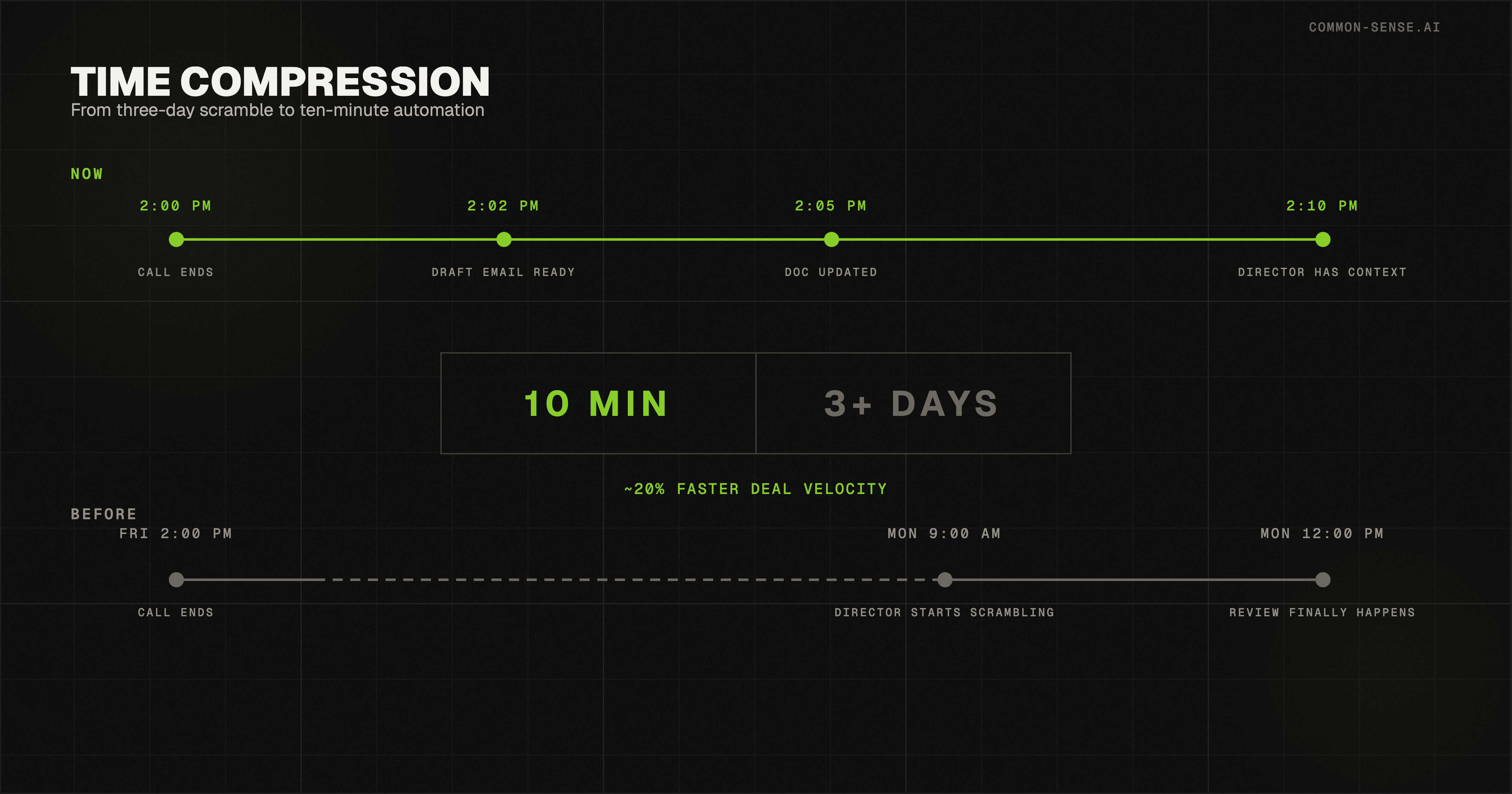
Ten minutes after a call ends, the sales director can open the document, and the context is there. SE prepping for Thursday's demo reads a document that reflects the last conversation, not the one from three weeks ago. Customer success inherits the full history of the relationship when they take over.
Nothing changed about the tools. Reps still use HubSpot, still use the same outreach platform, and still join calls the same way. Our system sits inside their existing stack. If it required a behavior change to work, we'd have designed it wrong.
Early signals show deal velocity improved by roughly 20%. Deals move faster when SEs show up prepared, when directors don't spend Monday mornings reconstructing the pipeline, when the next conversation picks up where the last one left off.
The document became the single source of truth.
Context that used to live in individual AEs' heads now lives in a system that the entire team can access. When a rep goes on vacation, the deal doesn't stall. When deals get reassigned, the new person picks up with full context. When someone leaves, the institutional knowledge stays.
As the system runs, it captures more. Every call, every update, every decision the AE makes about what to approve and what to reject feeds a growing picture of how this team wins deals. Which objections matter. Which stakeholder configurations predict complexity. Which follow-up patterns lead to next meetings.
2nd month's output is sharper than the first. 5th month's will be sharper still. They're accumulating an asset that gets more valuable the longer it operates.
Your sales team's context is leaking at every handoff. Find out where — and what it's costing you.
Get in Touch →